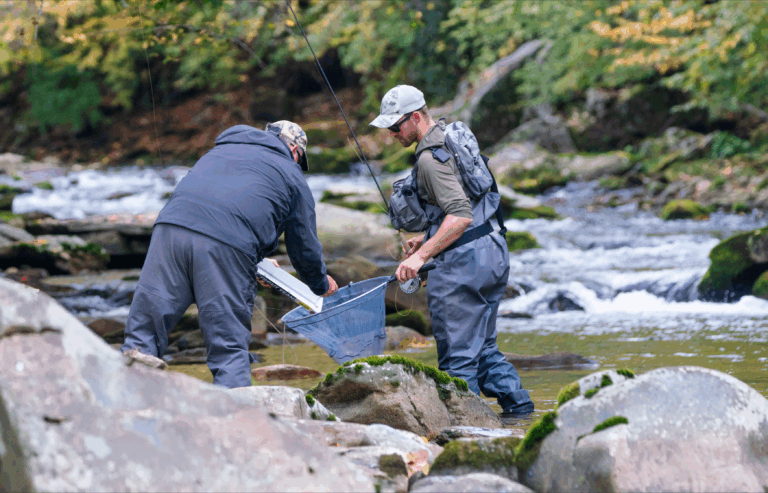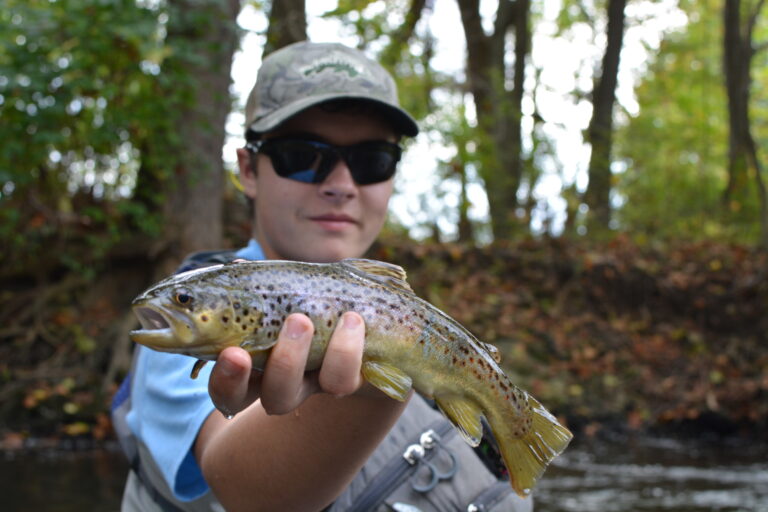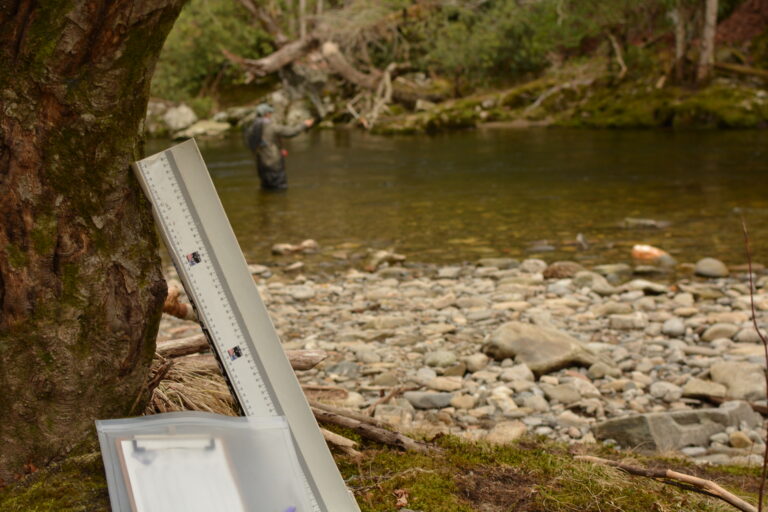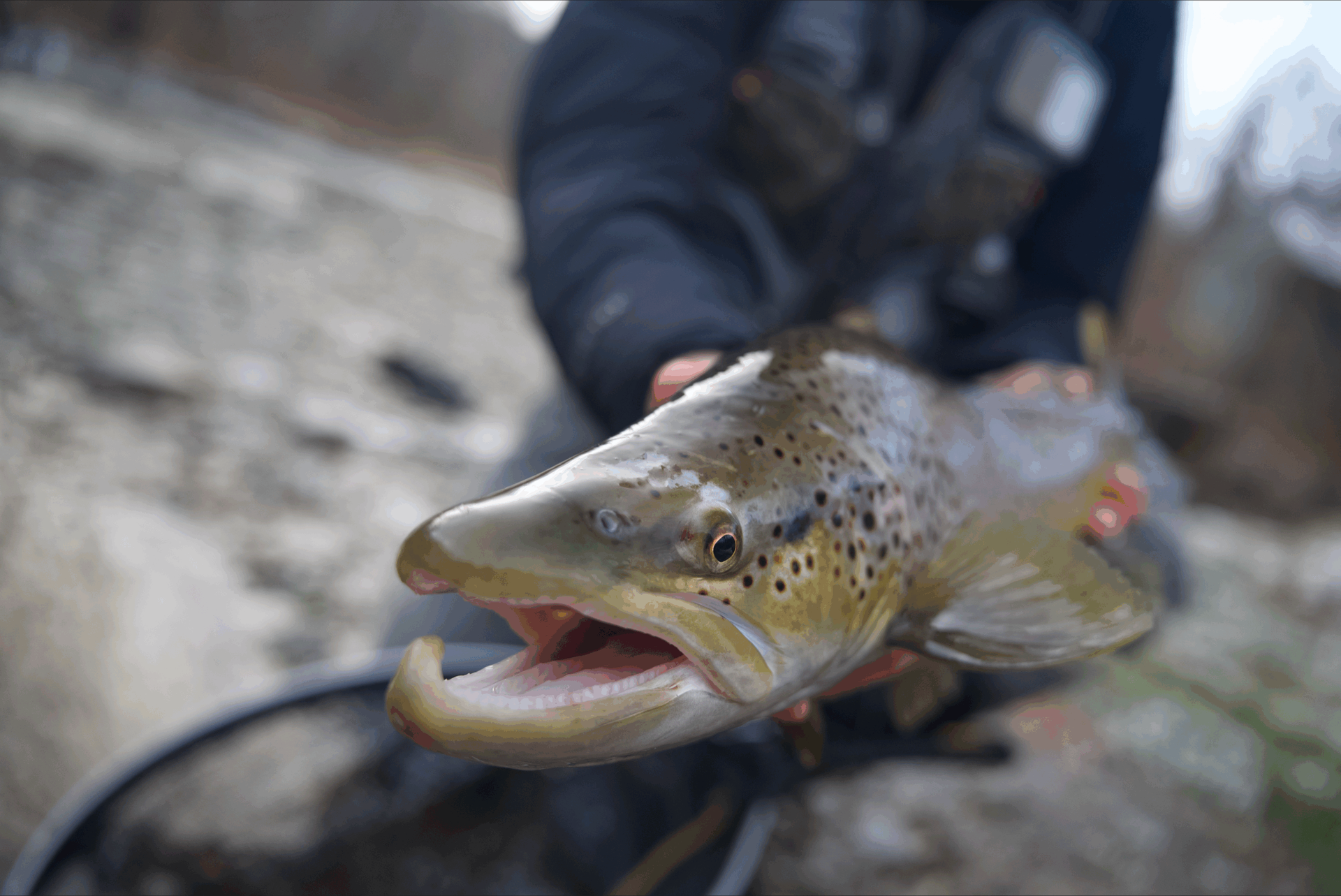

For Pennsylvania’s brown trout, fall means one thing — the spawn. It kicks off around Halloween and peaks through November, when the year’s biggest fish move into the shallows. We get fish on some rivers trying to get it going as early as mid-October, and I’ve seen fish still on redds until early January, but the vast, vast majority do their thing in November. As it rolls around again, so does the big question, “should we keep fishing?”
Don’t Target Fish on Redds
Leaving the fish on redds alone is what separates fishing during the spawn from fishing for spawning fish. Redds are the “nests” made by trout. The female digs a redd with her tail in rough gravel and deposits the eggs in it. If you decide to fish during the spawn, don’t target fish on redds.

That’s a non-negotiable. There is no ethical way to do so, no matter how you slice it. A fish on a redd is very close to dropping its eggs or milt already. The stress of being caught will usually cause it to drop prematurely, severely decreasing the chances of a fish that was about to spawn successfully.
On top of that, it’s just not sporting. Fish in a vulnerable position like that are not fair game, and catching one is not a show of skill or an achievement. They’re exposed, easily visible, have their guard much lower than normal, and are aggressive to the point that anyone can catch them. If they’re on gravel, just keep moving.
Why Start Caring During the Spawn?
Someone asked me this once and it took some thinking to actually come up with an answer. Fly fishing, despite the glamorization of recent years, is a blood sport. We accept the possibility of fish mortality at other points of the year, so why get caught up on it during the spawn specifically?
First off, because these are the fish that made it. There are a thousand ways for a trout to die before reaching the point of reproduction. The fish around during the spawn are the ones that beat the odds. They’re ready to pass on their genes and lay thousands of eggs to build up the future population. Catch a mature fish that dies after being released in May and you may have impacted reproduction, but catch one in November that dies and you almost certainly have.
I have heard anglers in the past say that mortality is actually higher during the spawn. I always thought there could be some merit to that as well, since the fish are experiencing massive hormonal changes and devoting energy to generating reproductive processes. I can’t find any science to back that up in trout specifically, but there is a study that found it true in a different flounder-like fish.
The spawn also makes the older age classes of fish more accessible to the average angler. These are the fish that are going to pass on the best genes to the most offspring. They are harder to land quickly and safely and are the fish most often played beyond exhaustion. Removing them from the system has a profound impact on the genetic health of future populations.
It’s not just about mortality — mature fish holding eggs or milt will drop them when stressed. If the eggs or milt are dropped randomly and not on a redd, there’s no chance of them contributing to the total reproduction. This is a larger concern compared to direct mortality, because it happens a much higher percentage of the time.
Does Pressure During the Spawn Have a Real Impact on Population Size?
I’ve talked about why fishing the spawn could be harmful, but I guess the real question is does it actually impact the future population? The answer is yes and no.
Angler pressure on most rivers has a negligible impact compared to the environmental conditions surrounding the spawn. The conditions are a global factor — they affect every fish in the system from headwaters to mouth, all day, every day. Anglers can’t do that. Though there’s never been a study, this seems to be the general consensus of many fisheries professionals and seasoned anglers I trust.
You can very easily correlate the relative prevalence of each age class year over year to the water conditions during their respective birth years. As far as I know, no one has been able to correlate the same to fishing pressure.

Conditions have such a large effect that I can actually see the results of a bad spawning year in the numbers of fish I catch associated with it (by size) for years down the line. Even though I’m pretty good, I think I’m still only getting a very small sample size of the total population. If I can see it, it’s a big factor.
That being said, anglers still have some effect. We can influence spawning success on a small or individual scale. Accidentally killing fish or causing one to drop its eggs still means a few hundred less fry the next spring. Scale it up to a few hundred anglers on a river over the course of the spawn and that can have a meaningful impact on the total reproductive success.
Though we as fly anglers will never have an effect on the scale of the water and weather conditions, I think we can influence the spawning success, especially the more of us there are out there.
How Do You Fish the Spawn Ethically?
If you want to fish for trout through the spawn, you have to do it right. The biggest thing to watch is the areas you target. Trout spawn on clean pea gravel, primarily in water shallower than three feet that moves at about the crawling speed of a baby. If you avoid water like this and focus on deeper pools, chutes, silty or bouldery areas, and heavier runs, you can significantly reduce the chance of impacting spawning fish.
You should also watch your success and limit your impact. There are eleven months of the year to catch 100 fish a day if you want, but you should probably hold off during the spawn. Catch a few, enjoy watching the fish do their thing, and move to another drainage or call it a day.
On a similar note, keep your impact to high-quality fisheries. Accidentally disturbing a fish in a 5,000 fish-per-mile river is a lot better than doing it in a 500 fish-per-mile river. There’s just a bit more room for error on those high-biomass rivers.
If you’re catching fish, play them quickly. The less stress they’re under the better. Up your tippet if you have to, but unless it’s a two-footer you shouldn’t be playing them for more than a minute. If you don’t have the skill to land and release fish quickly like that, it’s OK, but you should probably hold off on fishing during this period.
Finally, like I mentioned at the beginning, don’t target fish on redds. If you fish hard through the spawn, you’re going to see a lot of trophy fish right there for the taking. You may even cross paths with the fish of a lifetime. They’re easy targets, and it can be tempting, but you have to have the willpower to just walk past. People would be able to tell by the Instagram post anyways.
Don’t Tread on the Redds!
This often comes up when discussing fishing through the spawn, but in my opinion it’s a bit of a separate, bigger issue. Stepping in redds can cause notable egg and fry mortality. Two anglers wading over the same redd can kill pretty much all the eggs and fry there are, according to this study. It’s a big issue for sure, but it extends past the spawn itself.
If you’re fishing during the spawn you can see the redds. They’re big patches of bare gravel and usually stand out as light patches. All you have to do is be mindful and avoid stepping on them.
They get filled in fairly quickly though. A few weeks after the eggs are laid, the redds all but disappear, but they’re not safe to walk on until early spring. That’s a problem for us anglers fishing during that period.
If you fished or visited the river during the spawn, you can avoid the areas where you saw the active redds. Chances are, though, that you’ll end up on some new rivers or areas you have no prior knowledge of. If that’s the case, it’s best to avoid walking on the gravel areas that could support redds in general. Walk around, boulder hop, or find some new areas to fish until the fry leave the gravel.
Do I Fish Through the Spawn?
Fishing or not fishing during the spawn is an individual decision. I choose not to fish or guide for wild, stream-dwelling brown trout through the month of November. Mostly. I still take one or two short sessions to go out, fish some of the non-spawning water, and observe the habits of the fish. It’s important to understand how the spawn changes their activity and behaviors, but I never fish too hard. I also take a few trips to just go watch the fish on redds and see the caliber of fish that are really in my home waters.
No matter how you try to avoid it or play it safe, if you fish through the spawn, the chance you’ll have a negative effect on a trout’s or trout egg’s success is never zero. The more you fish and the more fish you catch, the greater that chance becomes. Putting too much pressure on them just isn’t worth it to me, especially when I could be fishing for musky.
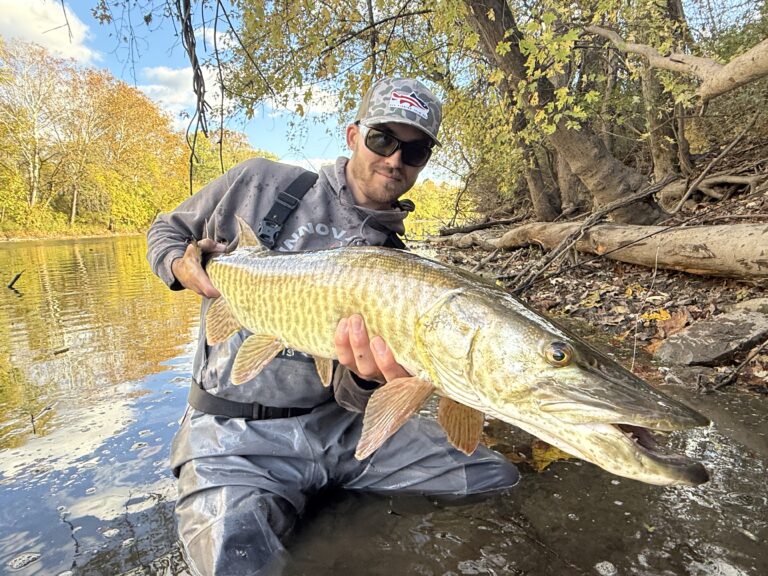
That’s just my personal preference though. Fishing through the spawn isn’t necessarily unethical when done thoughtfully. I don’t look down on the educated anglers that choose to do it, just because I don’t. It’s up to each of us to fish smart, do what’s right for us, and protect the population for generations to come.
— Mike Komara