
I have been a competitive fly angler for over thirteen years. When I started, very few anglers outside the competition scene even knew that it existed. In the years since, competitive fly fishing has grown exponentially and become a much more well known segment of the sport, influencing a large portion of modern trout tactics. With the growth of competitive angling, more and more anglers are becoming interested in giving it a try. Getting involved is easy, but not the most straightforward process. In this series, we’ll go over everything you need to know to get signed up for a competition, do well, and become a better angler.
What Is Competitive Fly Fishing?
There are a few types of fly fishing competitions, but here we are specifically talking about those run under FIPS Mouche (the international governing body of competitive fly fishing) rules. These can be anywhere from one to five day tournaments, but as a new competitor you will most likely only be doing the single day events. Any given competition will look pretty much the same: you’ll meet early in the morning before the competition starts to go through the rules and run the beat draw, then go compete or judge a total of four sessions, and finish up by going to an optional meeting for awards. There are no prizes for these competitions, just medals and the knowledge that you fished well.
We’ll get into the details of how comps work later, but on a high level, a fly fishing competition is mainly a numbers game. Our goal as competitors is to go out there and land as many fish as possible using whatever techniques are necessary and within the rules. Competitive fly fishing is most often associated with euro nymphing, but any given session may require dry fly fishing, streamer fishing, nymphing, or a host of other tactics. Competitions are really about being versatile, adaptable, and meeting the fish on their terms.
At the end of the day, you may be comparing scores with the other anglers, but in a fly fishing competition your real opponents are the fish and the clock. There’s no direct head-to-head competition with the other participants, just you out there in charge of your own success. It’s not too much different than any other day on the water, just with some added stakes. The desire to place well pushes you to fish harder and think outside the box when things get tough, but the goal of having fun and catching fish remains the same.
RELATED: The FIPS Mouche Rulebook
How Do Fly Fishing Competitions Work?
The format of fly fishing competitions can be a bit confusing when you’re first learning how they run. The good news is that you only have to figure it out once, because all FIPS style competitions run basically the same way. I’ve found the best way to explain it is by looking at a real world example, which for us will be a basic one day, twelve angler regional. This is the type of competition new competitors will start out fishing and is the easiest to understand. Before we get into that, though, let’s take a look at some of the terms we often use in competitive angling.
Competitive Angling Terms
If you’ve never competed before, there are some common terms that may be foreign to you, or some that have a different meaning in the context of a comp. Some of the ones you definitely need to know are:
Beat: A 100-400 yard section of water fished during a competition
Beat Marker: A colored flag or flagging tape denoting the top and bottom of a beat. Beat flags will have the beat number and a “B” or “T” written on them to indicate whether it is the top or bottom.
Buffer: An optional section of water between beats that no one fishes in the comp
Venue: A larger section of river that holds the beats to be fished
Session: The 1-4 hour (normally 2 hour) timeframe a competitor has to fish their beat
Group: The collection of anglers a competitor fishes directly against. The group will always have an even number of anglers.
Field: The overall group of competitors in a competition. The field will always have an even number of anglers.
Draw: The randomized list of where and when each competitor fishes and controls
Controller: The judge/scorekeeper for a session
Organizer/Host: The angler running the competition. They are often a competitor as well.
Ghost: An imaginary angler used to fill a vacated spot for scoring purposes
Fish Points: The points you earn from the fish you catch in your session that you compare with other anglers to determine your placing
Placing Points: The points you earn from your placing in a session
Blank: Catching no fish in a session
Regional: A one-day, 12-16 angler competition open to anyone
Interregional: A two-day, 24 angler competition that is invite-only
Nationals: A 3+ day, 40 angler competition that is invite-only
The Fly Fishing Competition Format
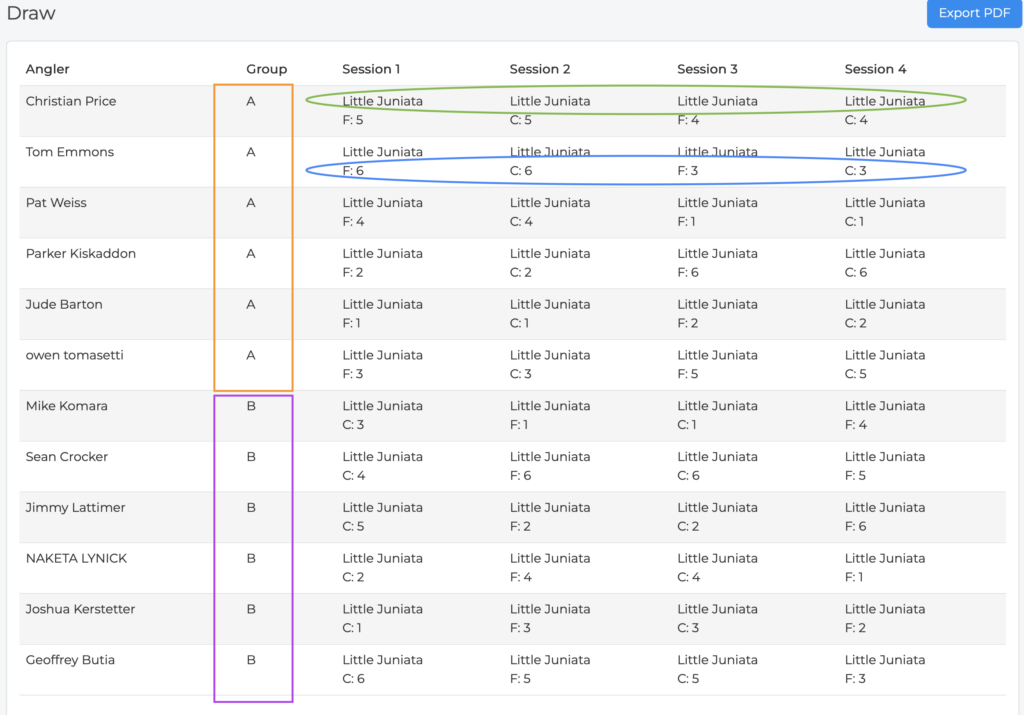
Now that we have the terms out of the way, let’s get into our regional competition example. Our regional is one day with four, two hour fishing sessions, has a field of twelve anglers split into two groups (A & B), and has 6 beats spread over one venue. In the morning meeting before the competition starts, the organizer will run the draw, and you will be able to see which group you are in, what beats you fish and control, and when. The draw and scoring are all done on a website called Flycomps, which we’ll discuss later.
Fishing and Controlling
All our competitions are what we call “angler controlled.” This means that as a participant, you will be both fishing and judging two sessions throughout the day. The controlling part is pretty straightforward: you watch your angler fish the session and keep track of the number of fish they fairly net while making sure they follow the rules and stay within their beat. The fact that groups switch off is why only six beats are needed for a field of twelve anglers.
In a regional with four sessions, you will always fish two and judge two. If you end up in Group A, you will fish the first session, control the second, fish the third, and control the fourth. If you end up in Group B, you will start by controlling a Group A member during session one, then fish, control, and finish the day fishing. One of the great things about fishing competitions is that the draw works in a way where everyone will control at least one beat that they fished the session prior. This offers a great learning opportunity to see how a more experienced angler may attack the water differently. The draw is also set so that no one will control a beat they later fish, to avoid giving anyone an unfair advantage.
Fish Points and Placing Points
You may be wondering, if one group is always controlling the other, how does that work with scoring? If all we looked at was the total number of fish over the day, the group that fished first would have an advantage because they got fresh water. To make sure no one has an unfair advantage, anglers only compete directly against those in their group.
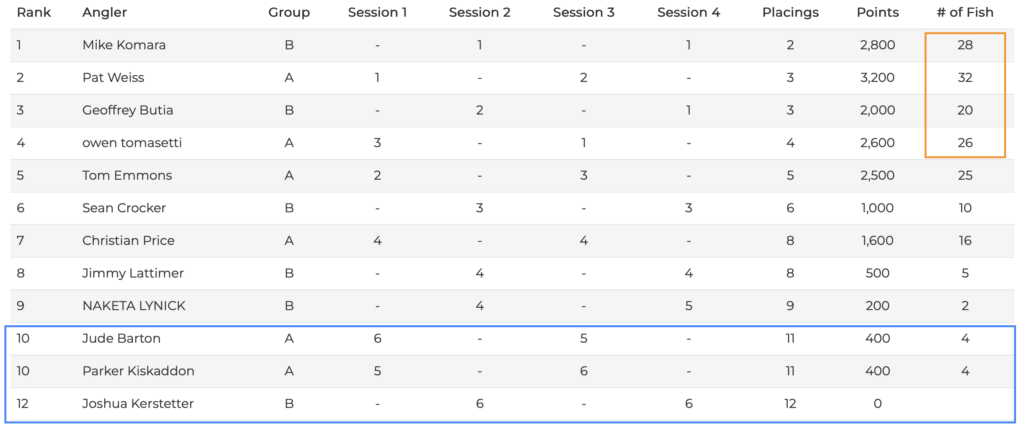
This is where fish points and placing points come into play. When you fish your session, each fish you net is worth 100 fish points. At the end of the session, you compare your total fish points (number of fish) with the other anglers in your group that just fished. The person with the most fish points wins the session and takes one placing point. The person with the second most fish points takes two placing points, and so on. The person with the least fish in a session, or any angler that blanks takes a maximum of six placing points. If two people have the same number of fish, they both take the lower placing point, and the next angler down is scored as if there was no tie.
At the end of the day, each angler adds up their placing points from the two sessions they fished to get their final score. Whoever has the lowest overall score wins the competition. If there is a tie in placing points, say an angler in Group A and one in Group B win both their sessions and have two placing points, fish points are used as a tie breaker. The angler that caught more fish would win. If they both caught the same number of fish as well, both anglers would share first place and the next angler in line would take third place.
Fish points may seem pointless since they are basically just a multiple of the number of fish an angler catches. In the context of a regional, where fish are netted and immediately released, and there is no minimum size, they are a bit pointless. However, when you get to larger competitions, like interregionals or Nationals, fish are measured. When an angler nets a fish, they run it back to their controller on the bank, who measures the fish in a score trough and then releases it. In these competitions, fish have to be at least 20cm to count, and every centimeter long they are is an additional 20 fish points. So a 20cm fish is worth 500 fish points total: 100 fish points for being landed, and an additional 400 fish points for its length. This is used to try and further prevent ties.
Ghosts and Other Edge Cases
Earlier I mentioned that the field and groups will always have an even number of anglers. That’s true in theory, but things happen. Sometimes anglers forget and don’t show up to the event, sometimes people get injured and have to leave, and sometimes they just decide they don’t want to continue. In the event that the field drops to an odd number of anglers, a ghost is added to one of the groups.
Ghosts can make things slightly easier for the anglers whose group they’re in. As long as an angler catches one fish, the worst placing point score they can get for a session is five. If someone blanks, though, they still get six. Ghosts also make things easier for anglers in the opposite group because they will get an unfished or rested beat.
The anglers assigned to control the ghost for their sessions will have no one to watch, so they can take a break or go watch someone else fish (but cannot go watch the next beat they fish). The anglers assigned to be controlled by the ghost will have to fish on the honor system and take pictures of the fish they catch. In general, a ghost makes things a lot more complicated, so if you have to drop out of a comp, please do so with plenty of notice.
How Do Things Change in Larger Comps?
We’ve gone over our basic case of a one-day, twelve-angler regional, but what happens when we start upping the size? If we’re still looking at one-day regional competitions, the only way we make them bigger is by adding more anglers. This is a pretty straightforward case, as the only changes are that the groups get larger and the number of beats increases. For a sixteen-angler regional, the groups are eight anglers instead of six, and there are eight beats instead of six.
The real changes start when the competitions get longer as well as larger. In a two-day interregional competition, anglers can fish four sessions instead of only two. For these competitions, the number of groups and venues doubles. Instead of just Group A & B, there will also be Group C & D. Group A and B are linked and will fish venue one on day one, and venue two on day two. Group C and D are also linked but will fish venue two on day one and venue one on day two. Everything else remains the same, though. It’s almost like two mini competitions are going on at once, and the combined score determines who wins overall.
Are Fly Fishing Competitions Fair?
A natural question that arises is: are fly fishing competitions even fair? The beats you fish, the time you fish them, and the anglers you fish against directly are randomly selected. No one fishes exactly the same water under exactly the same conditions against the same people. The truth is that luck can play a big role in how well you do, and there’s nothing we can do about it.
The organizers put a lot of work into making sure the beats are as even as possible, but there’s no way to make the distribution of actively feeding fish equal. On top of that, one angler in a group may have to fish a beat after someone who has competed for fifteen years and been to a dozen World Championships, while another fishes a beat after an angler competing for the first time. There are endless things that can make a session more or less fair for someone.
Fairness can fluctuate in individual sessions, but the more sessions you fish, the more it evens out. The hope is that things even out in the two sessions you fish in a day, but sometimes that’s not enough. The larger a competition and the more sessions you fish in it, the more inherently even and fair it will be. You may get one horrible beat that takes all your effort to scrape out a few fish, but your opponent may get two middle of the road beats while your next beat is a great one.
That’s why we care more about overall consistency than individual finishes. When you look at a season as a whole, there are some anglers who consistently place in the top three or five spots no matter what their group or beat draw looks like. They pull more fish out of bad beats and capitalize more on good beats. Some days that may not be enough to win a competition, but over the year it’s enough to give them a higher average placing than everyone else. I can’t say every competition is fair, but the best anglers always rise to the top when you look at the total scores.
The Rules of Competitive Fly Fishing
By now, you hopefully understand how fly fishing competitions run, but we haven’t talked about the actual rules and constraints you have to follow when you’re fishing your sessions. The full list of rules is available on the FIPS Mouche website here, but that document goes over a lot more than you need to know for your first competition. I still recommend reading it through, but these are the most important ones in clearer language.
RELATED: How I’d Fish Without FIPS Rules
Equipment Restrictions
In competition, you have to use a rod between 7.5 and 12 feet long and a continuous full-length 22m fly line no thinner than 0.022″ (no interchangeable sinking or shooting heads). As long as you’re within those constraints, you can fish pretty much any rod/reel/line combo you can think of. You’re also not allowed to add any floating or sinking devices to your system, so no indicators/floats, split shot, or sinking putty (paint, wax, and grease are OK). This is part of the reason euro nymphing emerged as a major technique in competitive angling. Nets must have knotless bags and be under 48″ in total length. The only real gear rule past that is that you can’t use any electronic devices; no smartphones, smartwatches, GPS units, sonar, etc. Regular wristwatches are OK.
Fly Restrictions
The biggest restriction on flies is that they must be tied on barbless single hooks only. Articulated or double-hook flies are not allowed. Flies can be weighted with a single visible round bead up to 4 mm in diameter; any other weight must be hidden within the body. Rubber legs are allowed, but any other molded or extruded silicone or rubber material is banned (so no squirmy worms, though chenille worms are allowed). If you’re fishing a single fly, it can be any size. If you’re fishing two flies, they must fit within a special gauge as shown.
Leader and Rigging Restrictions
Leaders may only be as long as double the rod length from fly line connection to the furthest point of the tippet, can be knotted or knotless, must be level or continuously decreasing in size (no increasing diameter tapers), and can be connected to the fly line by a knot or loop-to-loop connection (only one loop allowed per leader). Knots in the leader must be 30 cm apart, hanging freely. Tippet can be connected to the leader via a knot or tippet ring, but the connection cannot be slidable up and down the leader.
You can fish a maximum of three flies where local regulations allow. All additional flies must be tied off dropper tags, not tied inline off the eye or bend of the hook. Flies must be a minimum of 50 cm apart, hanging freely. Flies or dropper connections must not be slidable up and down the leader.
Eligible Fish and Angler Etiquette
Fish must be hooked fairly, in an area of the head in front of the back edge of the gill plate. They must be landed with an approved landing net, and some part of both the net and fish must be in the water when the fish is landed. Fish have to be released unharmed in a respectful manner to count.
As an angler, you must remain in the beat (or on the bank within an acceptable area) for the duration of the session. You can’t cast or otherwise fish outside your beat, whether there is another beat or a buffer bordering it. If a fish you’re fighting swims into another beat, you can fight it from your beat, pull it back into your water, and land it in your own beat. You must stop fishing when time is called, but you have ten minutes after your session to land any fish you hooked while the session was running.
Something not listed in the official rules, but that applies to our competitions, is etiquette regarding recreational anglers. When we run competitions, we don’t close or own the river for the day. Other anglers can still fish the water we are competing on for fun and have every right to do so. Competitors can let them know that there is a competition going on and that they may have more luck elsewhere, but cannot suggest or ask that they leave. All competitors must give recreational anglers an acceptable buffer and respect their right to fish. Competitors are also responsible for pulling the beat flags for their beat at the end of the last session of the competition.
How to Find a Fly Fishing Competition Near You
Virtually all the competitions that run in the US are sanctioned by Fly Fishing Team USA (the US Senior Team). As I mentioned earlier, the FFTUSA regionals are the competitions you’ll be starting with as a new competitor. Something that tends to put people off from trying competitive fly fishing, or makes them nervous, is that all these entry-level regionals run under the FFTUSA name. Don’t let that stop you. Yes, these are worth points toward making the team, but the majority of attendees are casual competitors not trying to make the team, or newer competitors like yourself.
All our competitions are hosted and listed on Flycomps.com. This is where you’ll register for competitions; all you need is a free account. Competitions are usually posted one to three months out, so check back regularly for new ones. There will be river and stillwater competitions listed. As a new competitor, you’ll want to start with a river competition unless you have some previous stillwater fishing experience, as stillwater angling requires a specialized set of gear.
Once you create your account, you can register for the competition you’re interested in when public registration opens, usually at 8 p.m. on a Monday two weeks before the comp. Make sure you’re ready to sign up right when registration opens and that you have a good internet connection, as many comps fill up within a few seconds.
If you make the registration, you’ll have to get yourself a Fly Fishing Team USA membership as well, which opts you into the team insurance. You can get a season pass for $75, or a one-day pass for $35 if it’s your first comp (you can turn it into a season pass by just paying the remainder). If you miss registration and end up on the waitlist, there’s no need to buy a membership unless someone drops and you make it into the comp. Check back regularly to see if you’ve gotten in. To compete, you’ll also need to pay a $25 entry fee to the organizer of the competition beforehand or the day of.
What You Can Learn from Competitive Fly Fishing and Is It for You?
Competitive fly fishing isn’t for everyone. Plenty of anglers give it a shot for a few competitions or a season and decide it’s not their thing. What many people don’t realize is that competitive fly fishing has two parts: the fly fishing and the competing. These are separate skills, and you have to enjoy both to like competitive fly fishing. If you don’t love competition as much as you love fishing, you may not like competitive angling, and that’s OK.
That being said, competitive fly fishing will turn you into an exceptional angler. Competitions require that you fish and think way harder than you would on any other given day on the water. There’s a certain intensity that you just can’t match fishing on your own. On top of that, you get to watch other great anglers fish the water you just fished and see how they do it, and generally hear how a large, talented group of fishermen and women approached the day. You learn skills, approaches, and ways of thinking that you won’t really be exposed to otherwise. After all my years of competing, I’m constantly learning new things and making new friends through the sport. It’s been a life-changing experience for me, and I’m sure it could be for you as well.
Tight Lines,
Mike Komara